As fitness professionals, we track clients' gains, measure their weight loss, and celebrate personal bests as we help them work toward their goals. But there is often an overlooked variable that determines whether a client reaches those goals or ends up in their doctor’s office: their baseline musculoskeletal condition.
Historically, the fitness industry has operated on a "fingers crossed" model with respect to musculoskeletal health. Clients are often introduced to relatively high-intensity exercises and programs are hoping their bodies hold up. When it doesn't, the client often drops out or leaves the gym for rehabilitation. But as experts in muscles and movement, shouldn't we be the ones identifying these risks even before the first rep?
A New Age for Fitness Professionals
We live in a predominantly sedentary world. Most people walking into a gym carry musculoskeletal limitations they don't even recognize. This doesn’t mean they shouldn't exercise; it means we are perfectly positioned to help them move safely and more effectively than they have ever done before.
Static Postural Assessments: The Window into Movement
Many trainers feel intimidated by assessments because when they think about them they often visualize complex gait analysis. While watching a body in motion is valuable, it is also difficult for the untrained eye to detect issues and stressful for the new client who likely feels anxious while a professional scrutinizes precisely how poorly they are moving.1
Static structural assessments (assessing the body while it isn't moving) are incredibly revealing and much more manageable at the outset of a program. Think of a palm tree with a permanent bend in its trunk. You don’t need to see it in a hurricane to know which way the prevailing winds blow. By observing static posture, you can see exactly where life’s movement stressors and musculoskeletal imbalances have manifested.
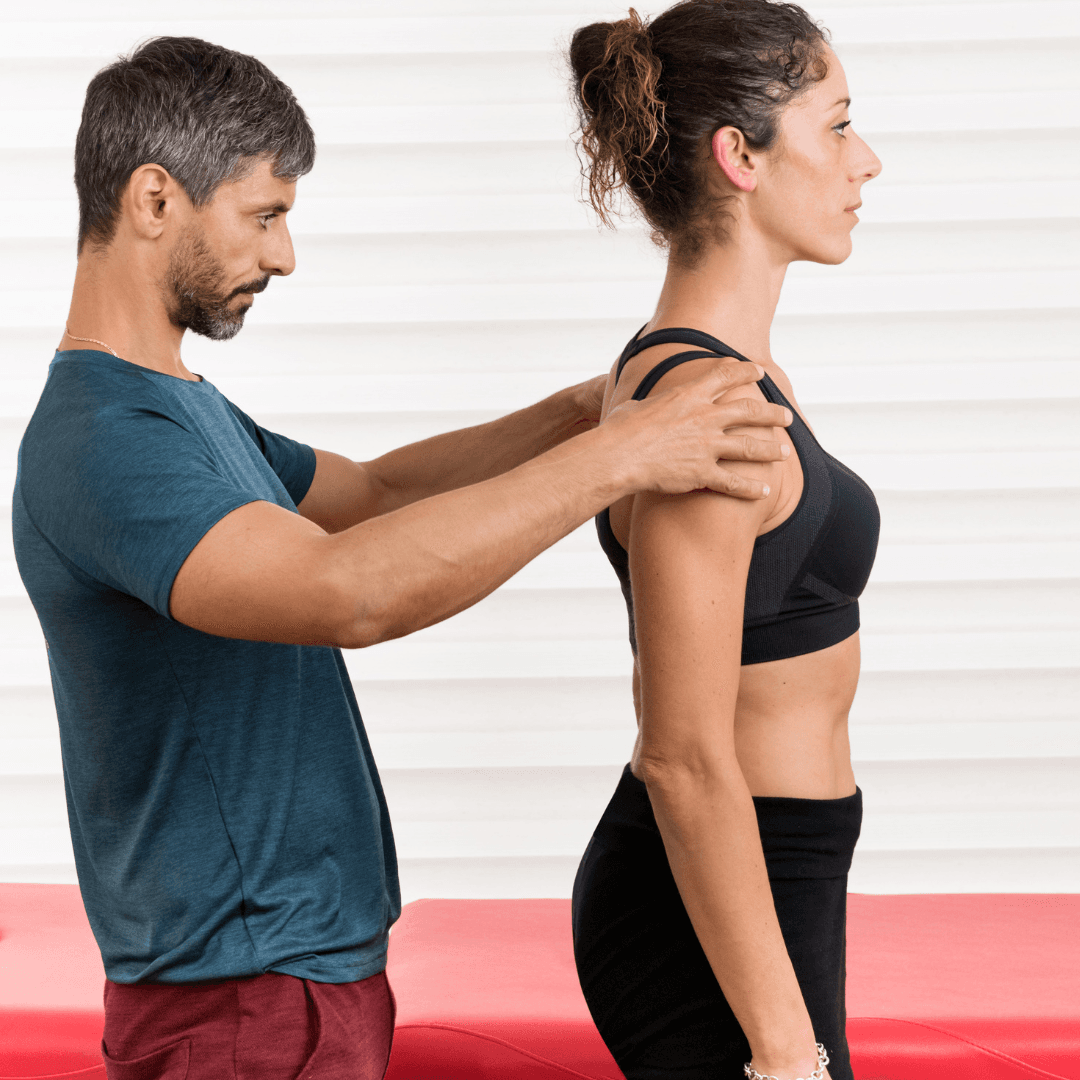
Structural assessments can provide insights into specific areas of the body as well as the musculoskeletal system as a whole.
The Chain Reaction
The body is a series of integrated systems. If one piece is out of place, the entire stack is affected. Here is a brief example of that what happens throughout the chain when one part of the body is out of alignment due to a common musculoskeletal imbalance:
- The foot: Overpronation causes the ankle to roll inward.
- The hip: This rotation moves the hip socket backward, tilting the pelvis forward.
- The spine: An anterior pelvic tilt creates excessive lower back arch (lumbar lordosis), which forces the upper back to round and the head to shift forward.
When you understand chain reactions like these, and can recognize them in clients, you stop chasing symptoms and start addressing causes.2
The Wall Test: A Simple Starting Point
You can implement these insights immediately with this Wall Test for lumbar lordosis from The BioMechanics Method:
- Starting position: Have your client stand with their heels, buttocks, shoulders, and head against a wall.
- Perform the test: Slide your hand, palm down, behind their lower back.
- Assess the result: You should only be able to slide your fingers in behind the client's back up to the second or third knuckle.
If your whole hand fits between the wall and the client's back, you’ve identified a red flag that this client’s lower back arches too much (i.e., excessive lumbar lordosis) and you should modify their program accordingly to avoid injury and improve their movement potential.2
Master the Art of Static Postural Assessments
Beginning all of your programs with structural assessments is the key to designing programs that are safe, effective, and truly personalized. By identifying these imbalances early, you provide the high-level care your clients deserve and ensure their long-term success.3
As your client experiences reduced pain and increased movement confidence, you will both gain momentum from these early successes. Once these fundamentals are mastered, you can then introduce movement analyses and complex assessments to further evolve their program.
Ready to stop guessing? Elevate your career by mastering the step-by-step assessment framework unique to the industry’s highest-rated corrective exercise specialist certification - The BioMechanics Method that will teach you how to identify and address structural imbalances from head to toe. Learn more here
Contributed By:
Justin Price is one of the world’s foremost experts in musculoskeletal assessment and corrective exercise and creator of The BioMechanics Method Corrective Exercise Specialist certification (TBMM-CES) available through Physiolution The BioMechanics Method is the fitness industry’s highest-rated CES credential with trained professionals in over 80 countries. Justin is also the author of several books including The BioMechanics Method for Corrective Exercise academic textbook, a former IDEA Personal Trainer of the Year, and a subject matter expert for The American Council on Exercise, Human Kinetics, TRX, BOSU, Arthritis Today, BBC, Discovery Health, Los Angeles Times, Men's Health, MSNBC, New York Times, Newsweek, Time, Wall Street Journal, WebMD and Tennis Magazine.
References:
1Price, J. 2026. The BioMechanics Method for Corrective Exercise. 2nd. Ed. Champaign, IL: Human Kinetics.
2Price, J. & Bratcher, M. 2019. The BioMechanics Method Corrective Exercise Specialist Certification Program. (2nd Edition). San Diego: The BioMechanics Press.
3Mccreary, E., Romani, W., Rodgers, M., Kendall, F. and Provance, P. 2005. Muscles Testing and Function with Posture and Pain (5th ed.). Baltimore, Md.: Lippincott Williams and Wilkins.